
Coeur d'Alene Address History Sources
The backward trail starts with today's parcel, then crosses sources by era. Kootenai County's property system supplies the present land key. Recorded deeds can extend the ownership line much farther back, while directories, census schedules, newspapers, school sources, and local history files add people who may not have held title.
| Source | Years covered | Where held | What it shows |
|---|---|---|---|
| Recorded real-property files | 1881 forward; online research from 1996 | Kootenai County Recorder | Owners, transfers, legal descriptions, plats, liens, easements |
| City and regional directories | Runs identified from 1923-24 through 1990, with gaps | Idaho State Historical Society; other repositories | Dated names, addresses, jobs, firms, and some household clues |
| Local research collections | Varies by item | Coeur d'Alene Library and Museum of North Idaho | Phone books, school censuses, probate, marriage, photos, papers |
| Federal census schedules | Public individual schedules through 1950 | National Archives and library resources | Household members and a dated place |
| Sanborn atlas | 1954 edition | Library of Congress | Building footprint, block, and use, not the occupant |
| Permits and planning files | Portal and office coverage varies | City and County development offices | Owners, applicants, work, issue dates, status, value |
Start with the source nearest the target year. For a recent transfer, use the Assessor and Recorder. For a mid-century household, pair the closest directory with the census and Sanborn sheet. For earlier work, expect office books, newspapers, cemetery material, and institutional collections.
Trace Kootenai County Owners Backward
The Kootenai County Assessor search can turn the current address into a PIN, AIN, legal description, and last-transfer instrument. That legal land identity is safer than a house number. The Real Estate Index then supports party, instrument, and legal-description work.
- Save the current parcel ID, owner as assessed, legal description, and last-transfer instrument.
- Find that instrument in the Recorder index and identify the buyer, seller, date, and exact land text.
- Search the seller as a grantee, meaning the person who received title, to locate the earlier purchase.
- Repeat while the legal description remains consistent, noting splits, combinations, plats, and easements.
- At the 1996 online boundary, take instrument, party, date, and book or page clues to the Recorder's office or mail-copy route.
The Recorder says its real-property holdings start in 1881. Online research starts in 1996. Those dates are not contradictory. They mark the difference between office custody and public web coverage. Copies are listed at $1 per page, with extra certification or return-mail charges where requested.
- Grantor
- The party giving or transferring an interest in land.
- Grantee
- The party receiving the interest.
- Chain of title
- The ordered series of transfers tied to the same land.
- Legal description
- The formal land wording that can remain useful after a street number changes.
Coeur d'Alene's Long Deed Record
Kootenai County was organized in 1864, but the Recorder dates its property files from 1881. The county seat moved to Coeur d'Alene in 1908. That sequence helps explain why a nineteenth-century person may appear first in territorial, federal, church, newspaper, land, or county material rather than in a city file.
Early work was paper-centered. Deeds, plats, probate, marriage and court filings, newspapers, cemetery cards, school materials, and directories sat with different offices or private institutions. The modern system is hybrid. A 1908 deed may require old indexing, a 1958 directory may be on reel or shelf, and a 1996 instrument may appear online. No documented countywide records disaster was found, so a missing item should not be called destroyed without proof.
Note: The 1908 county-seat move may change where an administrative clue appears, but it does not by itself change the parcel identity.
Coeur d'Alene Previous Residents in Directories
The official Idaho State Historical Society inventory identifies Coeur d'Alene and Kootenai runs on reels 18 through 21. Listed years include 1923-24; several years from 1931-32 through 1940; 1947, 1949, 1952, 1954, and 1955-56; then many volumes from 1957 through 1973. A separate shelf list adds 1927-28, 1963, and a 1973-90 run. These lists differ, so confirm the exact year and format before relying on a volume.
A directory entry is dated evidence, not a full census. It may show a householder, spouse, job, firm, phone, or address, yet omit other members. Reverse or criss-cross capability was not confirmed for every volume. The Coeur d'Alene city directory collections are described in full elsewhere; for previous residents, use the closest year before and after a transfer or census.
- Search the address and name in the closest available directory before the event year.
- Repeat in the next available volume, recording gaps rather than filling them by guess.
- Compare the result with the deed party and census household.
- Add a dated paper, school, cemetery, or probate clue to separate people with the same name.
A person can move between editions. A directory can also use an employer, business, rural route, or post-office box. Keep the publication year, page, repository, and address exactly as printed.
1950 Coeur d'Alene Households
The federal 72-year rule makes individual census schedules through 1950 available. The National Archives 1950 Census search supports a Kootenai County query. Coeur d'Alene had a final 1950 count of 12,198, compared with 10,049 in 1940 and 8,297 in 1930. Those numbers explain why earlier searches can be thinner than later records, but they do not identify a household.
The live county-filtered census search is the only successful image assigned to this previous-residents page.
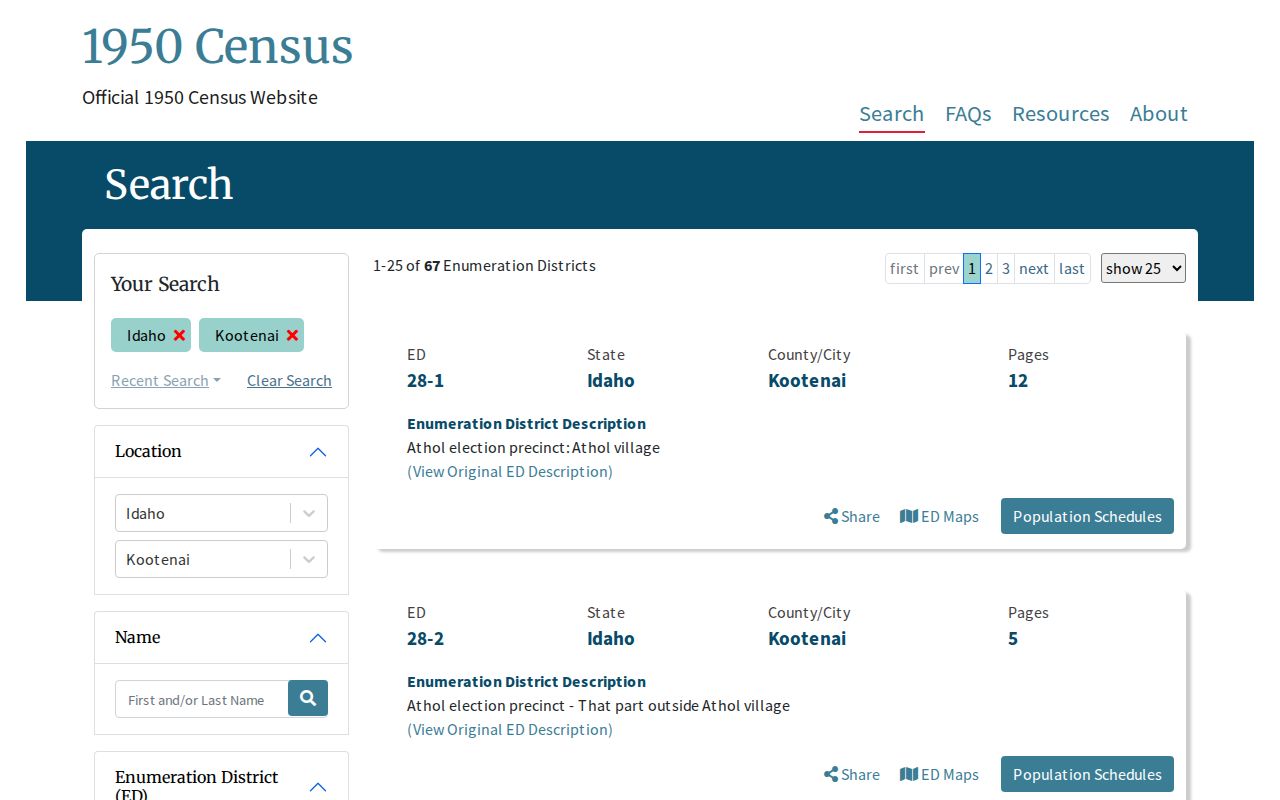
The captured search provides a dated household layer. Enumerator spelling, household order, and delivery conventions can differ from a directory or modern parcel card.
Pair a census with the nearest directories, then map the old address or enumeration area. A present ZIP cannot be treated as a historical census district without an address crosswalk.
Map Past Coeur d'Alene Buildings
The Library of Congress hosts a 1954 Coeur d'Alene Sanborn atlas with 38 sheets. A sheet can show whether a site held a dwelling, shop, school, church, garage, or other mapped structure. It does not name the occupant.
Use the Sanborn block and footprint to bridge an old street form to the current parcel. Then pair it with a directory name, newspaper notice, deed legal description, or later permit. This comparison is especially useful where a building was replaced or several lots were combined. Historic landmarks near Government Way, Sherman, Lakeside, Wallace, and the former rail depot can also help orient vague newspaper wording.
No official citywide street-number crosswalk was located. A Sanborn match should therefore include the sheet number, mapped use, nearby streets, source year, and the reason it aligns with the modern parcel.
Coeur d'Alene House History Collections
The Coeur d'Alene Public Library genealogy desk links cemetery data, archives, land, immigration, and newspaper resources. Its noncirculating Nelson Room Idaho Collection holds more than 2,000 local items, including photos, maps, papers, and ephemera. Some databases require a library card. The open Coeur d'Alene Digital Archives currently shows newspapers and high-school yearbooks, not a dedicated city-directory scan.
The Museum of North Idaho research library adds city directories, phone books, a 1910 state census index, school censuses, annuals, marriage abstracts, cemetery files, probate, homestead patents, photos, and oral histories. Visits are by appointment Tuesday through Thursday. Research is listed at $30 per hour, with the first hour complimentary for current members. Confirm the requested volume because not every item is online or remotely searchable.
These sources add the people layer to ownership. A photo caption, school annual, marriage abstract, or probate file can distinguish a past resident from a deed party with the same name.
Follow Coeur d'Alene Names Forward
Newspapers can close the trail after someone leaves an address. The Digital Archives includes the Coeur d'Alene Press and Union Boomerang, while state lists identify predecessor titles such as the Spectator, Enterprise, City Times, Independent, Sentinel, Journal, Evening Press, and Morning Journal. Search the title that existed during the event, not just today's paper.
The library says it does not maintain a Press obituary index. Its staff guidance works best with a person's name, month and year of death, and a specific date or page. An obituary can name relatives, a former home, funeral arrangements, and cemetery, but survivors listed in it did not necessarily live at the subject address.
Forest Cemetery reaches back to the city's 1905 Roosevelt proclamation, while Riverview is later. Cemetery choice can be an era clue. Museum probate and marriage indexes, FamilySearch's Kootenai-inclusive historical vital collections, and county court records can then test family links. Cite the title, date, page, and wording that connects the person to the place.
Resolve Old Coeur d'Alene Addresses
Keep two strings: the address exactly printed and a modern normalized form. Add the parcel PIN or AIN, legal description, postal label, city jurisdiction, time period, and a confidence rating. This prevents a current mailing label from being projected backward onto an old city boundary.
Use three anchors. The parcel anchor is a legal description, plat, or mapped lot. The street anchor is a directory, paper, census district, public map, or Sanborn block. The person anchor is a matching name plus family, work, school, business, cemetery, court, or event. Three agreeing anchors support a strong finding. One is only a lead.
Government Way, Sherman Avenue, Fort Grounds, Sanders Beach, and East Mullan appear in official planning or historic contexts. They can orient an old description, but a neighborhood label is not proof of residence. State what was seen, on which date, and what remains uncertain.
Limits on Coeur d'Alene Past Residents
Previous residents and past owners are not the same group. A trustee, spouse, lender, beneficiary, contractor, permit applicant, or return-mail recipient can appear in a property file without living there. A census or directory is closer to household evidence, but it is still a dated snapshot that can omit or misspell people.
Modern private data deserves restraint. Keep only fields needed for family history, estate or heir research, property history, or civic understanding. Verify living-person claims with the custodian and do not publish a current contact list from scattered sources.
Lawful use. Research Coeur d'Alene previous residents for legitimate house and family history. Never use a finding to track, stalk, harass, intimidate, or harm a living person.
A defensible final timeline lists each source, its date, the role of each person, the address form, land key, and confidence. It leaves gaps visible. That is more useful than forcing every deed owner, directory householder, and census member into one continuous household story.